Incident report form template
After an incident, the first few hours matter more than the paperwork. But the paperwork is what you will be judged on months later.
This form covers both parts. The person involved records what happened while it is fresh. The manager then works through why it happened, and what is being done about it.
What’s inside
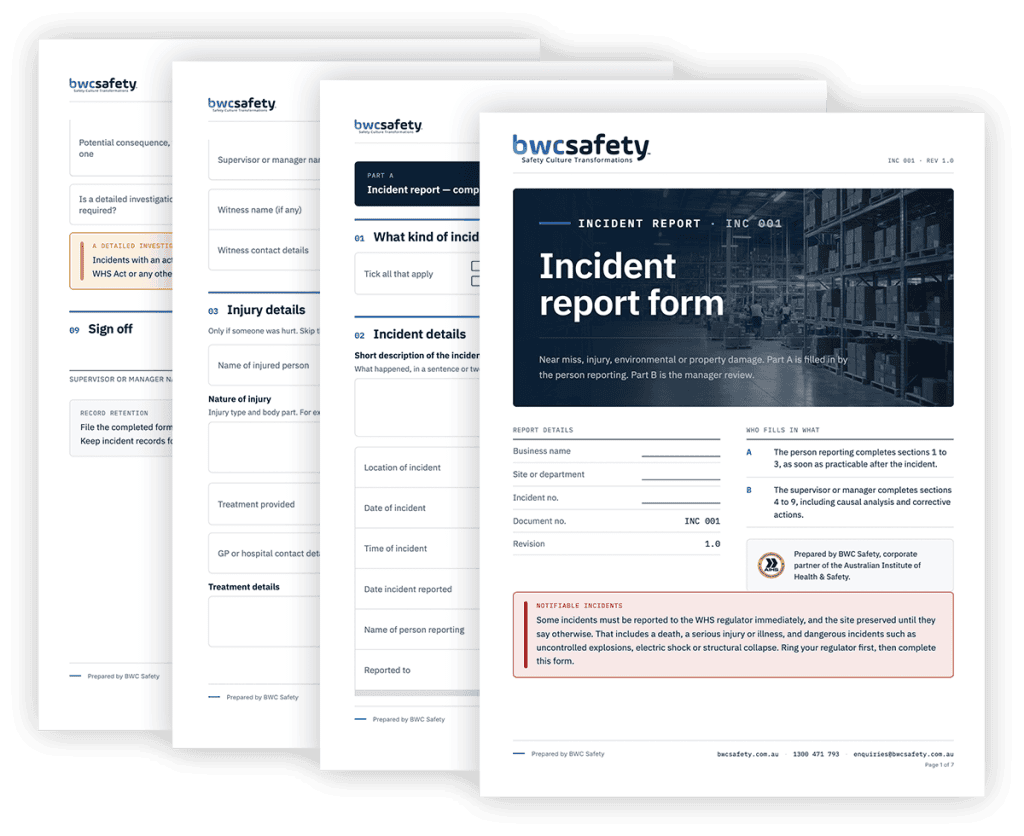
Seven pages, split into two clear parts.
Part A, filled in by the person reporting. Incident type, a short description, location, dates and times, who reported it and who they told, witness details, and injury details including treatment provided.
Part B, the manager review. What happened in full, causal factors, root cause analysis, corrective actions, consequence rating, and whether a detailed investigation is needed.
Causal factors, properly listed
The weak point in most incident forms is the cause section. A blank box invites a one-line answer, and the one-line answer is usually “worker error”.
This form gives you 25 specific factors across three groups: equipment, task and work environment, and management systems. Things like absent guarding, time pressure, inadequate supervision, poor maintenance schedules and operational goals that conflict with safety goals.
Tick everything that contributed. More than one box will usually apply, and that is the point.
Root cause analysis you will actually complete
“Ask why repeatedly” gets skipped. Five numbered boxes get filled in.
There is also a line reminding whoever fills it in that “the worker was careless” is a symptom, not a root cause. If that is where your analysis stops, the same incident is coming back.
Know what has to be reported
Some incidents must go to the WHS regulator immediately, and the site preserved until they say otherwise. A death, a serious injury or illness, and dangerous incidents like uncontrolled explosions, electric shock or structural collapse.
That sits in a callout on page one, because it is the thing people miss when they are rattled.
Fill it in on screen, or print it
The PDF is fully editable. Consequence ratings and yes/no questions are radio buttons, so you get one answer. The tick-all-that-apply sections let you tick as many as apply.
Signature lines are left blank for wet signing.
A template is a starting point
This is a well-built form based on Australian WHS practice. It is not an investigation methodology, and it does not replace a trained investigator for a serious incident.
If something significant has happened at your workplace, get help early. BWC Safety runs ICAM incident investigations, and our consultants each bring over 20 years of senior management experience across a wide range of industries.
Download the template
Tell us where to send it and the PDF will land in your inbox.
We’ll email you the document. We never share your details.