Welding safe operating procedure template
In January 2024 the workplace exposure standard for welding fume in NSW dropped from 5 mg/m³ to 1 mg/m³. That is a fivefold tightening, and plenty of workshops are still running the ventilation setup they had before it changed.
This safe operating procedure covers welding fabrication work from set-up to shutdown. Download it, add your business name, and put it in front of your crew.
What’s inside
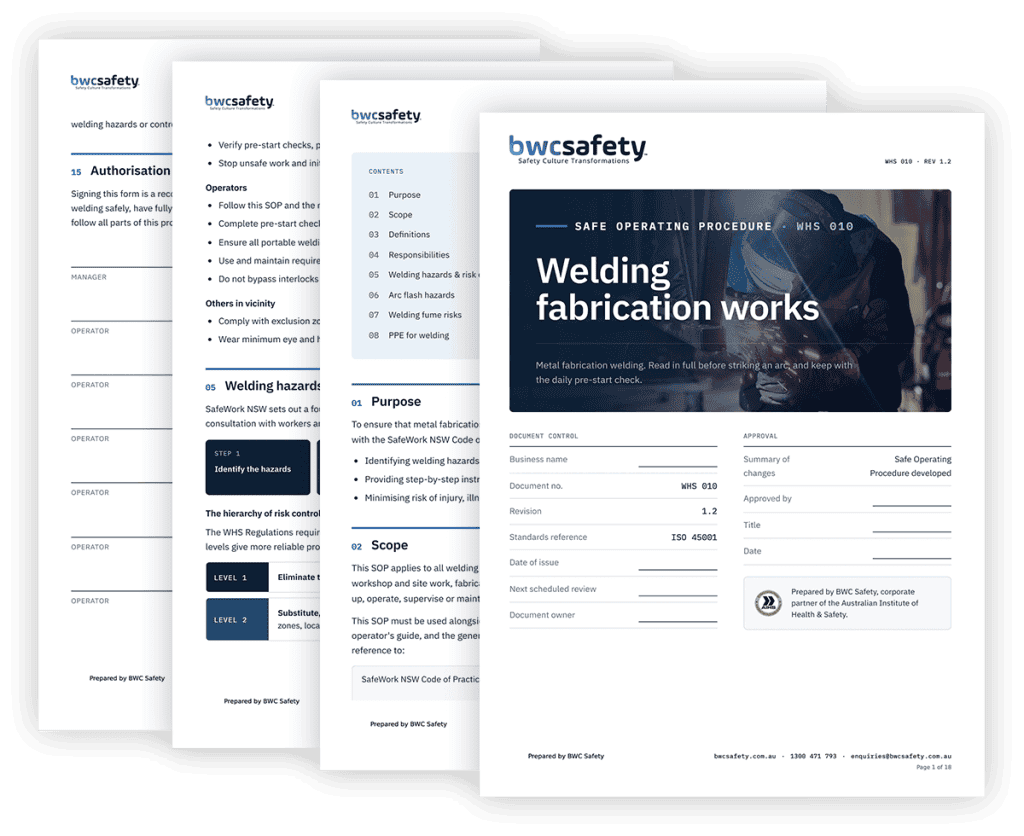
The document runs to 18 pages and covers the whole job, not just a PPE list.
- Purpose and scope, referencing the SafeWork NSW Code of Practice for Welding Processes, the WHS Act 2011 and WHS Regulation 2017
- Plain-English definitions: PCBU, WPS, hot work, LEV, PAPR and WES
- Responsibilities split by role, so managers, operators and bystanders each know their part
- The four-step risk process and the hierarchy of control, drawn out properly rather than described
- A hazard and control table covering electric shock, arc flash, fume, fire, burns, gas cylinders, confined spaces, noise, manual handling and trip hazards
- Pre-start checks across work area, electrical safety, cylinders and hoses, torch and wire feed, and parameter settings
- Step-by-step operating technique, including torch angle, stick-out and kickback-free practice
- Emergency response for electric shock, fire, gas leak, fume exposure and arc eye
- A sign-off page for your manager and up to six operators
Arc flash and fume, covered properly
Two sections get their own treatment because they are where welders actually get hurt.
Arc flash sets out what UV and infrared radiation do to eyes and skin, and explains the 10 metre rule, including why reflective surfaces push that distance further.
The fume section covers the health effects, the new 1 mg/m³ exposure standard, and the controls needed to meet it. Welding fume is classified by the IARC as a Group 1 carcinogen. Treating it as an irritant is no longer defensible.
A competency assessment form you can actually use
Most SOPs stop at the instructions. This one includes Appendix A, a full worker competency assessment.
Five prerequisite checks, a ten point knowledge check, and twelve observed practical tasks scored out of 24 against a clear rubric. There is a pass threshold, a judgement section covering restrictions, and declarations for both the assessor and the candidate.
Training records are the first thing a regulator asks for after an incident. This gives you one you can file.
Fill it in on screen, or print it
The PDF is fully editable on screen. Type into any field, tick the boxes, save it and email it. Yes and no boxes work as proper radio buttons, so nobody hands back a form with both ticked.
Signature lines are left blank for wet signing, because a scrawled signature on paper still carries more weight than a typed name.
A template is a starting point
Be honest about what this document is. It is a solid procedure based on Australian regulations and codes of practice. It is not a substitute for a risk assessment of your own site.
Your plant, your ventilation and your people are specific to you. Review it, change what does not fit, and make sure your controls match the actual hazards in your workshop.
If you want that reviewed properly, that is what we do. BWC Safety consultants each bring over 20 years of senior management experience across a wide range of industries.
Download the SOP
Tell us where to send it and the PDF will land in your inbox.
We’ll email you the document. We never share your details.