Psychosocial Risk Assessment & Management Program – Implementation Guide
A manager’s guide implementation guide
Background
The management of psychosocial hazards and risks is the hot topic in workplace health and safety in Australia in 2026. Each Australian State and Territory safety regulator has developed their own (similar) regulations and Codes of Practice. However, it can be daunting for leadership to grasp the requirements of the new legislation. As of May 2026, several large organisations have received fines from the regulator after they had gone through the process of psychosocial risk assessment but had failed to develop an action plan and monitor progress.
The purpose of this guideline is to assist executives and managers to understand what is required to fully implement a psychosocial risk management program. We have also provided some examples of the risk assessment process and management report that are typical of the approach adopted by firms that have had success in this area.
The Management Model
At its core, the model for managing psychosocial risks is the same as the model used for managing any OH&S system element. The PLAN-DO-CHECK-ACT model has been adopted by each regulator and the ISO 45001 Standard for OH&S Management Systems.
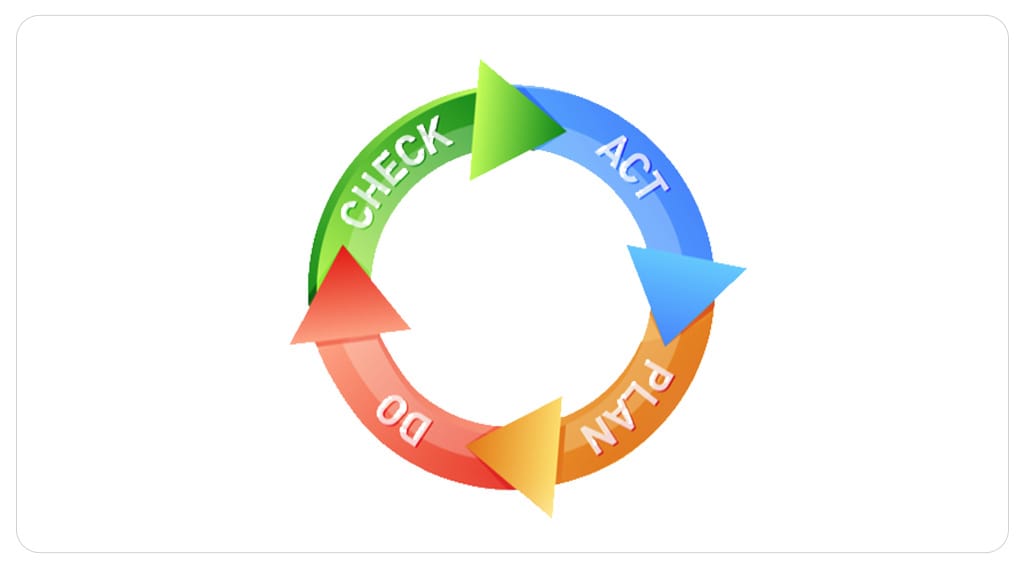
PDCA is an improvement cycle based on the scientific method of proposing a change in a process, implementing the change, measuring the results, and taking appropriate action. The PDCA cycle has four stages:
- Plan — determine goals for a process and needed changes to achieve them.
- Do — implement the changes.
- Check — evaluate the results in terms of performance
- Act — standardize and stabilize the change or begin the cycle again, depending on the results
The watchpoint for leaders is that ‘Planning and Doing’ are often completed well, but the process fails at that point. Leadership must ensure that they have processes for checking progress and making corrective actions where this is required. Executives and board members must ensure that the management of psychosocial hazards is included in their safety assurance program.
This guideline takes you through all phases of the cycle which is intended to be continuous and integrated into the business systems, not simply a one-off exercise.
Definition of Psychosocial Hazards
A psychosocial hazard is any aspect of work design, organisation or environment that can cause psychological or physical harm, such as stress, depression or burnout. These hazards arise from how work is managed or interactive behaviours, rather than just physical danger. Examples include high job demands, bullying, low support and poor change management.
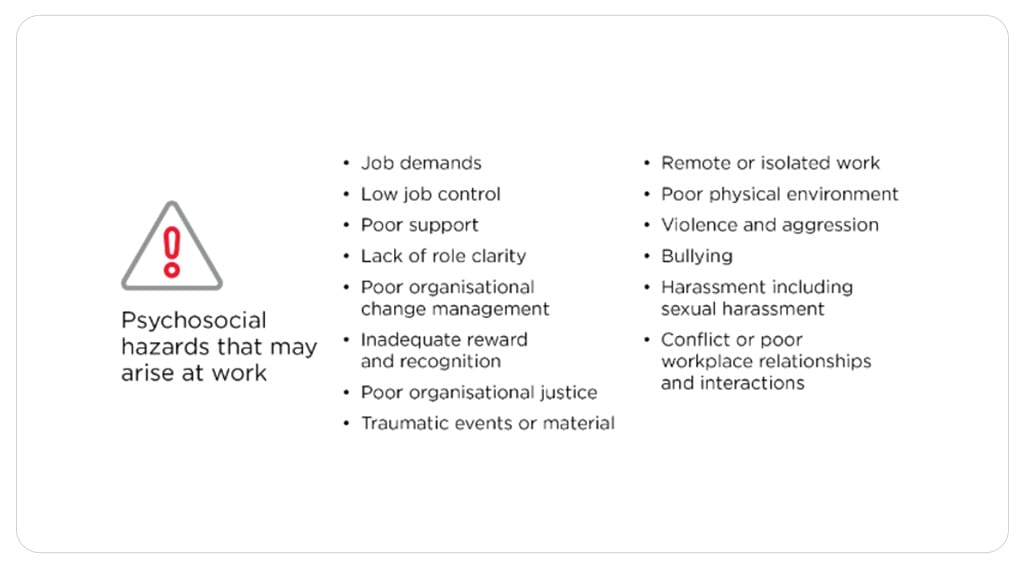
Common psychosocial hazards in the workplace
Legal Requirements for Managers
In all states and territories of Australia, employers have specific duties under the OHS (WHS) (Psychological Health) Regulations to manage psychosocial hazards in the working environment, so far as is reasonably practicable.
These include:
- Identifying psychosocial hazards;
- Assessing the level of risk associated with each hazard that is identified;
- Controlling any risk associated with a psychosocial hazard as set out in the OHS (Psychological Health) Regulations;
- Reviewing and, if necessary, revising risk control measures in specific circumstances.
If it is not reasonably practicable to eliminate a risk associated with a psychosocial hazard, the employer must reduce the risk so far as is reasonably practicable, by altering:
- The management of work, or plant; or
- Systems of work; or
- Work design; or
- Workplace environment; or
- Using information, instruction or training; or
- Using a combination of any of the controls listed in (a) and (b).
Risk Management Framework for Psychosocial Hazards
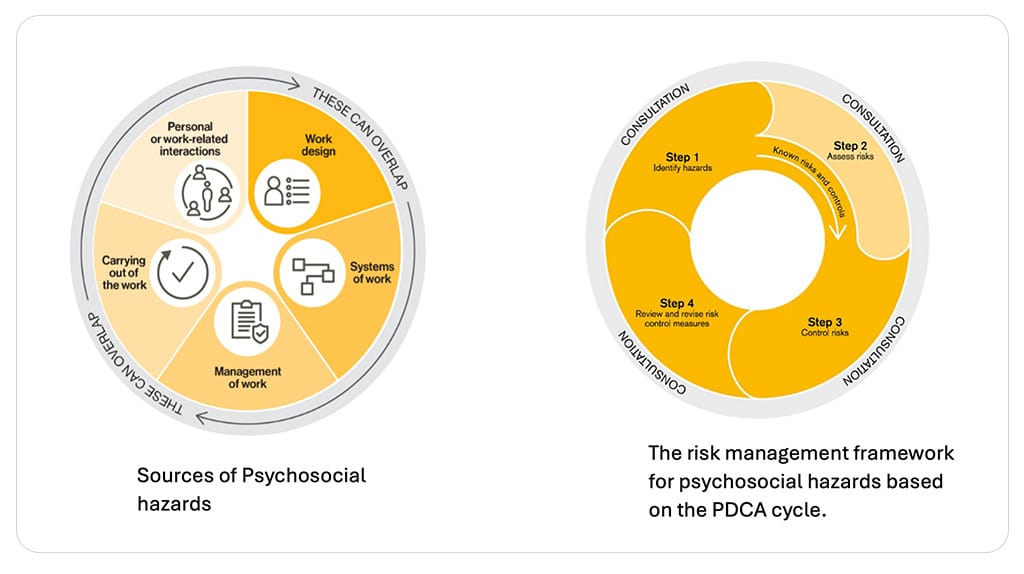
All state regulators take a similar approach where five broad sources of psychosocial hazards are considered and the standard risk management framework is applied for assessing the level of risk in each case.
Identifying Hazard and Assessing Psychosocial Risks
Start with a desktop review
In accordance with Steps One & Two of the Risk Management Model shown above, data should be gathered from a wide number of sources, including:
- Policies and procedures related to the management of psychosocial hazards.
- Workers’ compensation claims or incident records related to psychological harm.
- Feedback from staff, including mental health first aiders and OH&S committee members.
- Employee Assistance Program quarterly summary reports.
- Minutes of OH&S committee meetings which discuss psychosocial hazards.
- Employee complaints and investigation reports.
- Employee alignment & Engagement Surveys.
Gather High Quality Feedback
The importance of gathering high-quality feedback directly from a wide cross section of staff cannot be under-estimated. The success factors here are high trust, confidentiality and experience. In most cases this will require an external consulting organisation who specialises in this area to conduct confidential 1:1 interviews using a question set that has been developed using the regulator’s code of practice. The number of staff to interview varies with the size of the organisation and is part of the planning process, however we have found that a minimum of 10% of staff from across all departments in a medium sized organisation (200 people) provides reliable and consistent feedback. Typical roles will include executives, operations managers, senior staff, Health & Safety Representatives and members of the OH&S Committee and then a general cross section of staff from all departments and levels of experience. Normally, interviews require approximately one hour to complete and holding them online via Teams places staff at ease.
Surveys have their Place
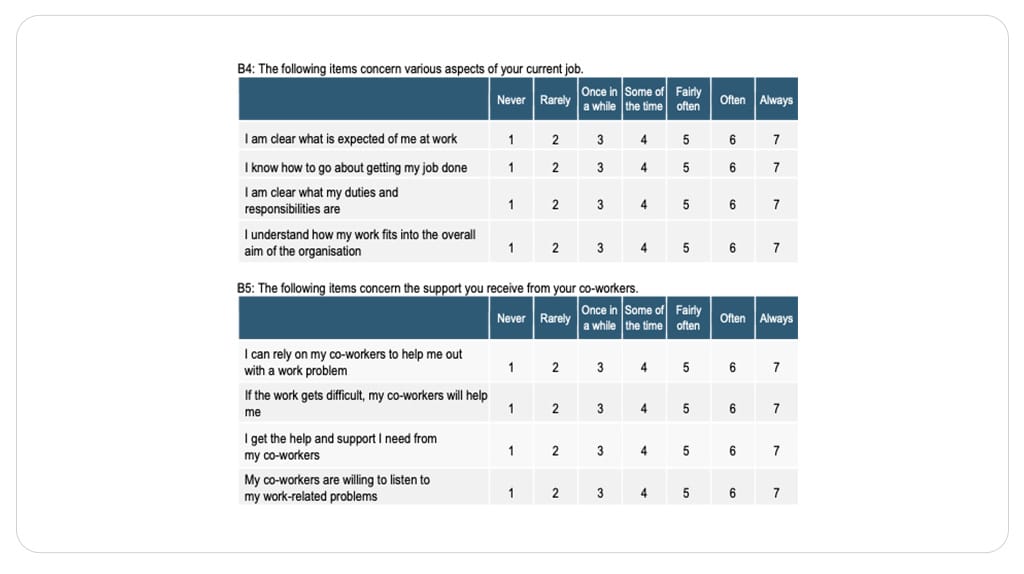
For larger or more complex organisations, feedback from confidential surveys may be augmented with confidential surveys which are consistent with the regulator’s requirements and have been validated. Examples include the ‘People At Work’ survey, which is a validated question set approved by WorkSafe Victoria. Survey platforms must ensure data security and be at the SOC2 standard.
The Psychosocial Risk Assessment Report
A management report should be developed after the psychosocial risk assessment has been completed. The report should be concise and provide the following information:
- Executive summary
- Regulatory references and an explanation of the methodology used
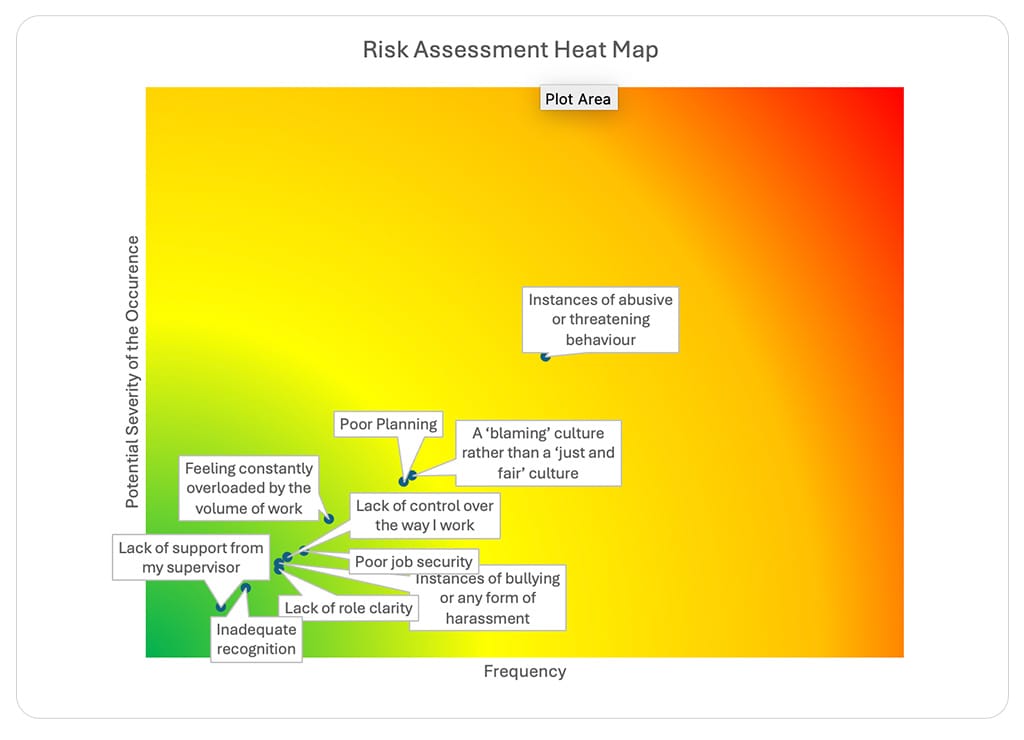
- Collated findings from the confidential interviews and surveys. For each psychosocial hazard identified, the frequency of occurrences and the potential severity must be provided. A Heat Map is often used to clearly illustrate the high priority issues.
- The report must contain clear recommendations for implementing corrective actions, aligned to a validated psychosocial risks framework, such as the model recommended by WorkSafe Victoria and described in the next section. Without this reference framework as a guide, it is likely that the organisation will miss opportunities to either eliminate the hazard or minimise the risk so far as is reasonably practicable.
- A draft Implementation Plan should be developed from the recommendations. Ideally this should then be reviewed, discussed and approved in an executive leadership workshop.
Framework for Controlling Psychosocial Risks
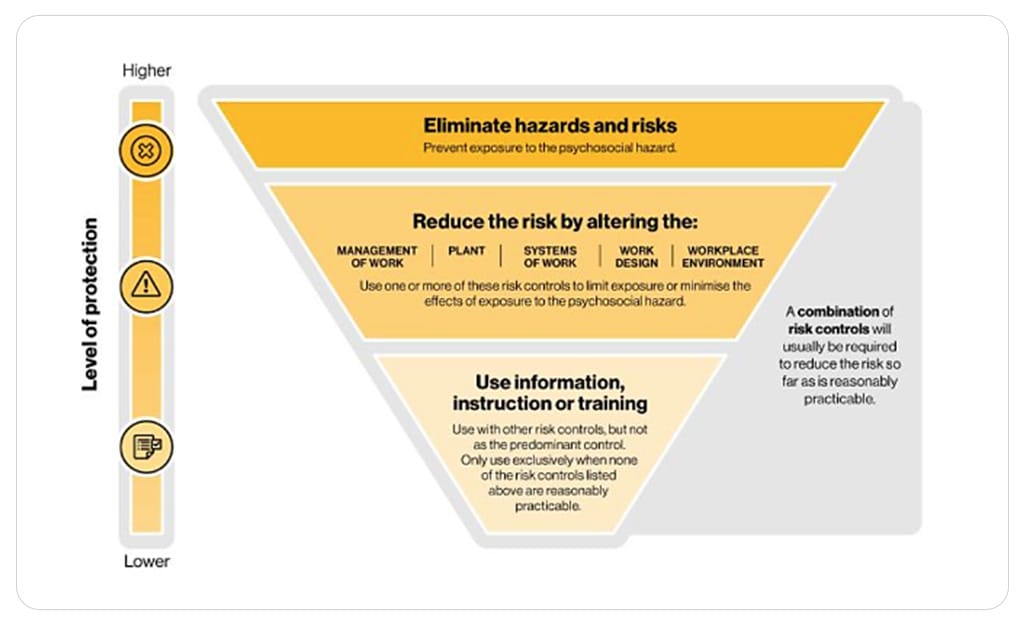
Now that psychosocial hazards have been identified and the level of risk assessed, the psychosocial hierarchy of controls is applied to either eliminate the hazard or if not possible in the circumstances, to minimise the level of risk. The schematic provides an overview of the process –
Practical Implementation of Controls
By reviewing the Psychosocial Risks Framework, it can be seen that there are options to either eliminate the hazard completely or reduce the degree of risk associated with psychosocial hazards. Although every organisation is different there are common and proven solutions which are listed below.
One management trap we see often, is to only consider solutions such as EAP and mental health first aiders. While these are excellent and should be part of the management arsenal, there are also effective strategies involving the way that work is designed and managed. We have summarised recommendations from WorkSafe Victoria below to provide some guidance as these should be built into the Implementation Plan that is developed.
Management of Work
Risk control measures related to management of work could include:
- Reviewing current work processes to eliminate unnecessary administrative processes.
- Arranging work rosters or processes so employees can vary tasks that require high concentration or are physically demanding.
- Providing a clear management reporting structure.
- Ensuring employees have the necessary qualifications and experience for their roles, and are appropriately inducted and trained as part of recruitment and onboarding.
- Supporting flexible working arrangements.
- Upskilling leaders in health and safety, including how to how to effectively manage complex staffing matters; for example, workload, poor workplace behaviours, bullying and sexual harassment.
- Demonstrating leadership commitment to managing psychosocial hazards.
Plant
Risk control measures related to plant may include:
- Repairing any plant that is regularly malfunctioning and causing frustration or increased work pressure for employees.
- Replacing equipment with new models that create less noise or vibration.
- Regularly servicing and maintaining all plant.
Systems of Work
A system of work encompasses the way that work is planned, organised and done. This may include the interacting set of policies, procedures, practices, equipment, materials and environment. Policies and procedures on their own are not systems of work. Included in this section are supporting systems such as Employee Assistance Programs, Mental Health Triage and Workplace OHS Committees.
Work Design
Work design means the equipment, content and organisation of an employee’s work tasks, activities, relationships and responsibilities within a job or role. Employers should consider how altering work design can reduce the risk of exposure to psychosocial hazards.
For example, consider if:
- Employees have an appropriate amount of responsibility for their skills and experience.
- Employees have the right resources and equipment to do their work.
- Tasks can be scheduled at more suitable times. For example, schedule high-risk tasks when employees are likely to be more alert or when more support is available.
- Tools or equipment can be adjusted to reduce hazardous manual handling risks that may create a psychosocial hazard. For example, anti-fatigue matting or sit–stand desks.
Workplace Environment
The workplace environment includes environmental conditions that contribute to psychosocial risks, such as lighting, temperature, noise or vibration. Making alterations to the workplace environment could include:
- Considering the layout of the office. The layout should minimise unnecessary exposure to other employees; for example, facing computer screens away from the centre of the office.
- Providing a secure lockable space for employees, good lighting and visibility in the workspace where there is a risk of harm from aggression or violence.
- Installing physical access barriers, surveillance cameras or duress and alarm systems to reduce the risk of harm from aggression or violence.
- Providing access to private spaces in the workplace to ensure the confidentiality of sensitive conversations.
Information, Training and Instruction
It is a legal requirement that employers provide adequate information, training and instruction to their employees. Our experience has been that managers and staff require training in understanding their roles and responsibilities; identifying psychosocial hazards; in implementing effective controls and monitoring effectiveness. Honing leadership skills in this area of safety is also a common need.
Monitoring Progress
Employers have a legal duty to review and, if necessary, revise the psychosocial control measures in place if circumstances change or if there are any indications that the controls may not be working as expected. This particularly applies if an incident occurs.
Monitoring incidents related to psychosocial risks is essential and should be done in consultation between management and employees using processes such as Health and Safety Committees, OHS team reports and reports from EAP providers where available. Senior managers should personally ensure that the management of psychosocial hazards receives regular attention and periodic management and OHS committee reviews of psychosocial risk registers ensure a systematic approach.
Senior management should include psychosocial hazard management as part of the overall management reporting process, ideally with trend analysis. Board members and executives should ensure that their OH&S teams have arranged to include psychosocial hazard management in their OH&S assurance program.
Final Note on Internal Capability
It is self-evident that this is an OH&S topic that has received the attention of safety regulators and State Governments, due mostly to the high levels of workers’ compensation claims. The legal requirements to identify, assess, control and monitor psychosocial hazards is well documented and conceptually straight-forward. For many organisations, the difficultly arises with interview confidentiality and also having the experience to identify which controls should be applied. We have found that engaging an external consulting firm who specialises in this area fills the knowledge gaps within the organisation and ensures the process stays on track.
About the Author: Bernie Walker

Make an Enquiry
Ensure your organisation isn’t making critical WHS mistakes by getting expert advice before it’s too late.
We are known by the company we keep